The Open Meeting Myth: Showing Up Is Not the Same as Taking Part
Open meeting participation depends on more than an invitation. Use clear advance information, fair speaking turns and accessible ways to contribute.
The common mistake with an open meeting is to assume that putting the door on the public agenda makes participation possible. Open meeting participation can still cost a resident an evening of wasted travel, a missed chance to speak or the effort of challenging a process they could not understand in time. Before you attend, check how the meeting works; if you are organising it, make those details visible before anyone has to ask.
What does an open invitation actually let you do?
Start by separating access from participation. An open invitation may let you enter a room or join an online call. It does not necessarily tell you whether you can ask a question, make a statement, submit a written comment or influence the decision.
Read the notice, agenda and any linked participation guidance. Look for the meeting’s purpose and status: is it for sharing information, gathering views, debating options or making a decision? These are different activities, and the same public seat can offer very different opportunities.
Check who is convening the meeting and who has authority over the subject. A council committee, a regional partnership and a community forum may each handle public input differently. If the notice does not identify the chair, decision-maker or contact person, ask the organiser before you plan around the meeting.
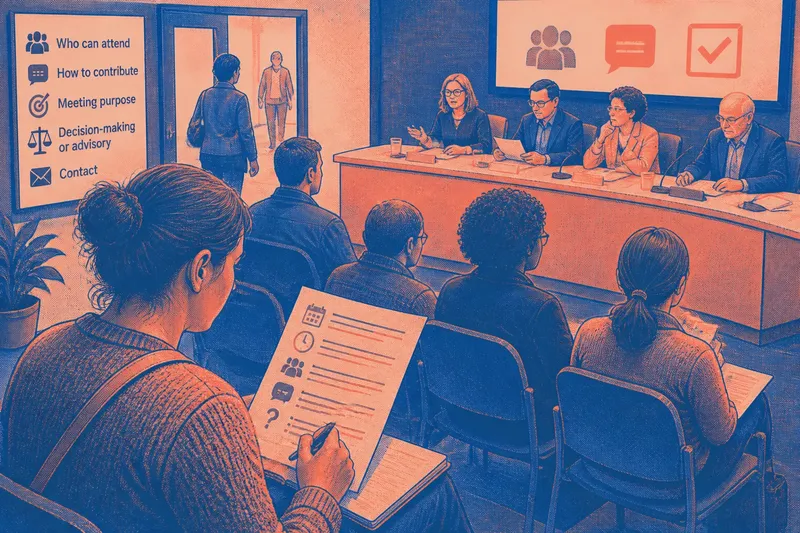
For organisers, state the invitation in usable terms. Say who can attend, what contribution is welcome, how to make it and whether the meeting is advisory or decision-making. “The public may attend” describes a door; it does not describe a way in.
What should you find out before you go?
Look for the practical information that lets you prepare without guessing. Check the venue, start time, expected finish, agenda, papers, registration requirements and contact details. If an online option is offered, find out whether it is for watching only or also for speaking.
Read the agenda in order. Note which item concerns you, whether public comments are invited at that point and whether the chair takes questions before or after discussion. If papers are missing or an agenda item is vague, send a concise query to the named contact. Ask what decision is expected and when comments can be made.
Organisers should share papers early enough for people to read them and arrange any support they need. Use plain language for technical terms, explain acronyms, and identify attachments by name rather than relying on unexplained links. If material changes, mark what has changed and how residents can respond to it.
Keep your preparation focused. Write down the point you want the meeting to hear, the question you need answered and any detail that supports them. A short note is easier to use under pressure than a long statement that depends on having uninterrupted time.
How can you make a useful contribution?
Choose the route that matches your aim. If you want a factual answer, send a question through the stated channel. If you want decision-makers to consider a concern, make a comment that links the concern to the agenda item. If you have information in a document, ask whether written submissions are accepted and how they will be circulated.
When speaking, name the relevant agenda item, state your main point first and make a clear request. For example, ask the committee to explain how it will notify residents before changing a local service, rather than giving a broad account of every problem with that service. You can add detail if the chair allows more time or asks a follow-up question.
Say you are attending a library meeting about proposed changes to opening arrangements. You have only a short slot and want the committee to consider evening users. You could say that people who work standard daytime hours may lose access, ask whether an evening option has been considered, and request that the committee record its response before deciding. The observable result to look for is a clear answer, a recorded request or an identified next step—not automatic agreement.
If you cannot attend, ask whether a written comment can be submitted, read into the record or included with the papers. Ask about the deadline and whether your name or contact details will be published. A written contribution is not automatically treated the same as speaking, so confirm how it will reach the decision-makers.
Are there other ways to take part?
Can you speak without registering first?
Check the notice or contact the organiser, because some meetings require advance registration while others take questions from the room. Ask what information registration requires, when it closes and whether you can still attend if you miss the speaking deadline.
Can you contribute remotely?
Ask whether remote attendees can speak, use chat or submit comments, and whether someone will monitor those channels during the meeting. If the online link is for viewing only, request another way to contribute rather than assuming a visible audience has a speaking turn.
Can you ask for access support?
Contact the organiser about interpreting, step-free access, hearing support, a quiet space or materials in another format. Explain what would help you participate, without sharing more personal information than is needed to arrange it.
What if you cannot attend at the scheduled time?
Ask whether the organiser will accept comments before or after the meeting, or provide a recording, minutes or written outcome. These options are not interchangeable: minutes may record a decision without capturing every contribution, so request the record that serves your purpose.
What makes speaking turns fair?
A clear turn-taking system helps residents understand when they can contribute and helps chairs manage a meeting without relying on who feels most confident interrupting. Before the meeting, organisers should explain how people signal that they want to speak, whether comments are limited to a set topic and how follow-up questions are handled.
At the meeting, the chair can name the order of speakers, acknowledge anyone waiting and explain if a contribution must be redirected or shortened. Use the same rule for people in the room and those joining remotely. A laptop queue or a raised hand should not disappear from view simply because the chair is dealing with the room.
As an attendee, listen for the stated process and follow it. If you are not called, ask the chair or clerk how to be added to the list. If your point is cut short, ask whether you may send the remaining detail in writing. A respectful request for clarification is more useful than assuming silence means your contribution was recorded.
Organisers should explain what happens when there are more speakers than the available time. Options may include taking comments in writing, grouping repeated questions while preserving distinct points, or arranging a further session. Whatever method is chosen, tell people how their contributions will be represented and where they can see the response.
How can you tell whether your contribution was heard?
After the meeting, check the minutes, decision notice or action log. Look for the issue you raised, the response given and any named follow-up. A record need not reproduce every word, but it should distinguish a question, a comment and a decision where that distinction matters.
If the record is unclear, write to the clerk or organiser with the date, agenda item and the point you believe is missing. Ask whether the record can be corrected or whether a written note can be attached. Keep your message factual and specific; the aim is to make the public record more useful.
For an organiser, close the loop with a short update that says what was decided, what remains open and how public input was considered. If no decision was made, explain what happens next and when residents can expect another opportunity to contribute. Do not imply that attendance itself means people supported the outcome.
What should organisers fix before the next meeting?
Review the journey from invitation to response, not just the number of chairs in the room. Ask whether a resident could discover the purpose, read the papers, understand the speaking rules, request support and learn what happened afterwards without relying on personal contacts.
- Write the meeting purpose and decision status in the notice.
- Publish the agenda, supporting papers and a named contact in one easy-to-find place.
- State speaking, registration, written-submission and remote-participation arrangements.
- Offer a clear route to request access support and explain how personal details will be used.
- Tell attendees how turns are managed and how the chair will handle questions that need follow-up.
- Publish minutes or an outcome note that identifies decisions, outstanding issues and next steps.
Think of an invitation as a key: it can open the door, but it cannot tell someone where to go once inside. Open meeting participation becomes more meaningful when people can see the route from preparation to contribution to response. For your next meeting, start with one practical question: could a resident who has never attended before tell, without guesswork, how to be heard?