Before the Regional Boundary Had Its Familiar Name
Learn how to separate a regional name’s current use from claims about its past, using maps, records and careful wording to assess what each source shows.
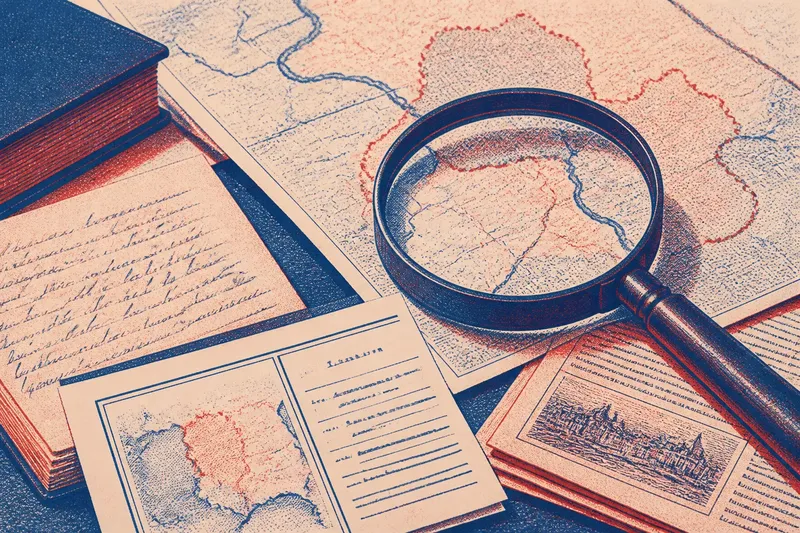
The common mistake with a familiar regional name is to treat its present-day meaning as timeless. That can turn a name used for a district, route or community into an unsupported claim about an ancient boundary. To understand a regional name, start with what a source actually says, then ask when and how it uses the term.
What does the name refer to now?
Begin with a current, specific use. A regional name might appear on a council map, in a tourism leaflet, on a transport route or in everyday conversation. Those uses can overlap without describing the same area.
Write down the source and the thing it names. Does the name refer to an administrative area, a landscape, a service network, a cultural region or a broad direction? A council boundary may be legally defined; a regional identity may be understood differently by people living nearby. Neither use automatically settles the other.
For example, if a bus operator calls several towns a single region, that may describe a service area rather than a historic territory. The name is real in that context, but its meaning is bounded by the operator’s purpose.
Which situation are you in?
- You are reading a current public document. Use the name in the sense the document defines. Check its map, glossary or boundary description before applying it to places beyond the stated area.
- You are comparing older and newer maps. Treat each map as evidence of how its maker categorised space at that time. Note the date, publisher, purpose and scale; a road map and an administrative map answer different questions.
- You are checking a claim about the name’s origin. Look for the earliest source you can identify, then distinguish the first surviving written use from the moment people began saying it. Those are not necessarily the same.
- You are writing about local identity. Attribute the name to the people or institution using it. A resident’s sense of belonging can be meaningful without matching a boundary on an official map.
- You are weighing a disputed account. Set out the competing uses and the evidence each relies on. Avoid declaring one meaning the only authentic one unless the evidence supports that narrower claim.
This sorting matters because a regional name is more like a street sign than a sealed label on a box: it can direct people to a place without defining every association they attach to it.
What can older maps and records establish?
Maps can show that a name was printed in a particular form and placed over a particular area. They do not, by themselves, establish that everyone used the name, that its boundary was settled or that its meaning matched today’s. Look at the legend and the map’s purpose. A label centred across a broad area may be a convenient caption, not a precise border.
Written records need similar care. Search local directories, gazetteers, council documents, newspapers, estate papers or transport records where relevant. A mention can establish that the term appeared in that document. To make a broader claim, look for other independent sources and compare how they use it.
Keep the evidence in a simple note: the exact wording, the source, its date, the place it concerns and what it can reasonably support. If a record says “the western district”, do not silently convert that phrase into the modern region’s full name. Preserve the original wording and explain your interpretation separately.
How should you describe a name’s changing meaning?
Use language that marks the difference between evidence and inference. “The name appears on this map” is narrower than “the region was known by this name”. “The council uses the term for these communities” does not claim that residents share a single identity.
Say you are preparing a short account of a valley now marketed under a regional brand. You find an older map that uses a similar name for a nearby upland, while a local council document applies the modern label to a wider set of towns. You could explain that the name has been used for different areas in different sources, then identify which source supports each use. The reader can see the distinction without being asked to accept an unproven continuous boundary.
Useful wording includes “in this document”, “on this map”, “in current council usage” and “the surviving record shows”. Avoid phrases such as “has always meant” unless you can substantiate the full span implied. A name’s apparent continuity may conceal changes in administration, transport, commerce or local convention.
Which questions help you assess a past claim?
What is the earliest recorded use of the name?
Identify the earliest source you can locate and state that it is the earliest one found, rather than the first use ever. Earlier spoken use may have left no written trace, and a surviving record may be incomplete.
Did the name describe a boundary or a broad area?
Check whether the source draws a line, lists places or simply prints a regional label. A broad label may indicate a recognised area without specifying where it begins and ends.
Who used the name, and for what purpose?
Consider whether the source came from a local authority, map publisher, trader, visitor or community group. Its purpose helps explain why the name was applied and what kind of area it was meant to describe.
Does a similar spelling prove the same meaning?
No; spelling can persist while pronunciation, reference or scope shifts, and similar forms may have separate explanations. Compare the surrounding text and location before treating two uses as continuous.
When should you leave the origin uncertain?
Leave it open when the evidence is thin, contradictory or too late to support the claim being made. That is a clear editorial judgement, not a failure to finish the story. You can still describe the current use, identify the earliest evidence you found and say what remains unknown.
Be especially cautious when an origin story is repeated without a traceable source, or when one version neatly serves a present-day boundary or identity claim. Repetition can make a story familiar, but it does not add independent evidence. Seek the underlying record rather than counting how many places repeat the same account.
If the name carries cultural significance, avoid treating documentary silence as proof that a community did not use it. Written records preserve some voices more readily than others. Where appropriate, distinguish archival evidence from oral accounts and attribute both clearly, without forcing them into a single chronology.
How can you write about the name responsibly?
Before publishing or sharing an account, check that each sentence signals the right level of certainty:
- State whether you mean a current administrative area, a cultural region or a historical label.
- Name the source behind claims about earlier use.
- Separate a recorded spelling from a claim about spoken use.
- Describe map labels and drawn boundaries as different kinds of evidence.
- Attribute contested meanings to the people or documents that use them.
- Mark gaps plainly instead of filling them with a confident origin story.
For a regional name, the most useful account often explains not just where the label appears, but what each use can and cannot tell you. That distinction lets a familiar name remain part of local life without making its past seem simpler than the evidence allows.